
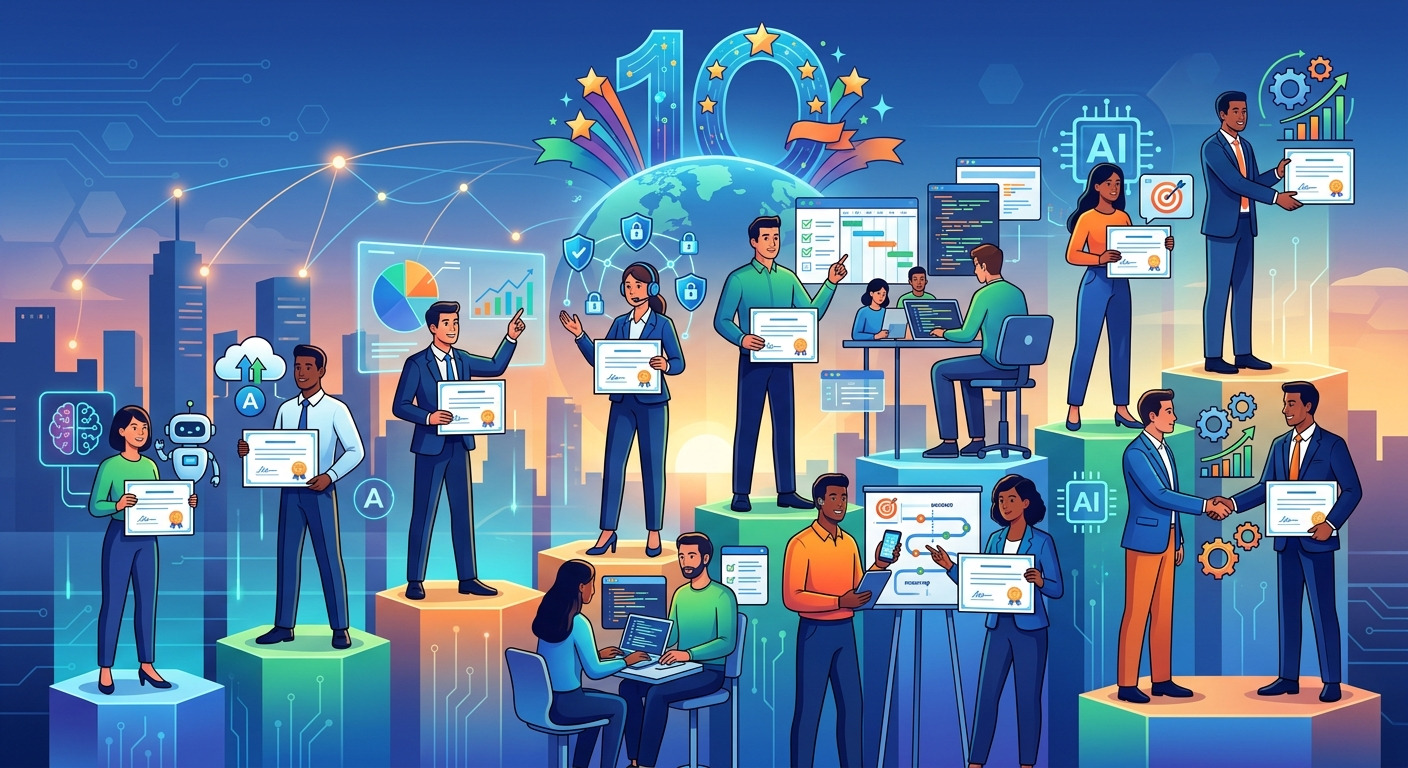
Top 10 Most In-Demand Skills You Can Certify Today
The job market is evolving rapidly. Companies are no longer looking only for people with theoretical knowledge, but for professionals who can act, make decisions, and solve problems in real-world contexts.
Today, employability increasingly depends on applied and demonstrable skills.
That is why microcredentials are becoming so important: they make it possible to train specific competencies, generate evidence of performance, and adapt quickly to changing professional needs.
At SmartSim, we support this approach through a platform for creating courses and microcredentials with practical experiences, simulators, and AI-powered feedback.
These are some of the most in-demand skills today that can already be trained and certified.
1. Decision-Making in Complex Environments
Organizations need professionals capable of analyzing information, evaluating scenarios, and acting under pressure.
Making decisions in uncertain situations has become one of the most valuable competencies across nearly every industry.
2. Applied Strategic Thinking
It is no longer enough to simply execute tasks. Companies are looking for people who can understand context, anticipate impact, and connect decisions with strategic objectives.
Strategic thinking enables professionals to act with vision and prioritize effectively in changing environments.
3. Business Data Analysis
The ability to interpret data and turn it into useful decisions is increasingly important.
This is not only about technical knowledge, but also about identifying patterns, risks, and opportunities that generate real impact.
4. Communication and Influence
Communication skills are no longer limited to speaking well.
Today they involve:
- persuading,
- negotiating,
- communicating ideas clearly,
- and managing complex conversations.
Especially in hybrid environments and multidisciplinary teams, this skill makes a major difference.
5. Project Management Under Uncertainty
Modern projects are constantly changing.
That is why organizations value professionals who can adapt, reorganize priorities, and manage risks without losing focus on results.
Flexibility and responsiveness are essential.
6. Real-Time Problem Solving
Solving problems quickly and effectively is a critical skill.
This involves:
- analyzing situations,
- identifying root causes,
- evaluating alternatives,
- and acting effectively under pressure.
Companies especially value the ability to respond to unexpected scenarios.
7. Leadership and Team Management
Modern leadership is no longer based only on supervising tasks.
Today it requires:
- building trust,
- managing conflict,
- motivating teams,
- and facilitating collaboration.
Especially in dynamic environments, human-centered and adaptable leadership creates enormous value.
8. Emotional Intelligence in Critical Situations
Emotional management is one of the most important — and at the same time most difficult — competencies to develop.
Knowing how to handle tension, pressure, frustration, or difficult conversations directly impacts professional performance and workplace relationships.
9. Adaptability to Change
Digital transformation and market speed require continuous learning.
Organizations need people who can quickly adapt to new processes, technologies, and ways of working.
Adaptability has become a competitive advantage.
10. Results Orientation with Real Impact
It is not enough to simply complete activities. What matters is generating measurable results.
More and more companies value professionals who are goal-oriented, capable of prioritizing actions, and able to create tangible business impact.
Learning Can No Longer Be Only Theoretical
There is a huge difference between understanding a concept and knowing how to apply it in a real-world situation.
That is why methodologies based only on content are losing effectiveness compared to more experiential and practical models.
Today, the key is not only to learn.
It is to train.
The SmartSim Approach
At SmartSim, we develop a platform for creating courses and microcredentials focused on practice, decision-making, and applied assessment.
Through simulators, dynamic scenarios, and AI-powered feedback, participants can train skills in environments that are much closer to real professional situations.
Because the most important competencies are not memorized.
They are developed through action.

You may also like

Employability 4.0: Certifying Strategic Skills in Real Time

How Microcredentials Drive Employability